The HERRING-BONE

The Braid
Saturday, February 14, 2009
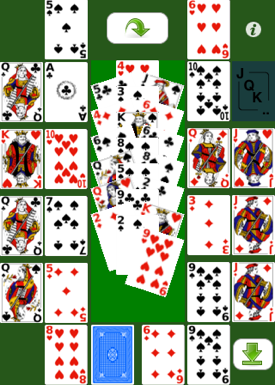
This game is one of the best free cell games that I know. It is challenging, but requires only little planning ahead. The english name is “The Herring-Bone” (established by Lady Cadogan, 1914). In Germany its original name is “Der Zopf” (The Braid or The Plait). So this game is also known as Braid in some solitaire applications.
The goal is to build the 8 wrap-around foundations to the left and the right of the tableau. Using the 8 dark green and the 4 light green free cells. The light green free cells are linked to “The Braid” in the center (light green). You are allowed to fill them with cards from the braid. All free cells can be used to hold cards from the waste that may be useful soon.
The biggest decision is wether you start building the families up or down. The screenshot on top shows when the foundations are not yet decided for up or down. Hint: Count the cards that are lower and higher than the first card of the foundations. In the screenshot we have 3 A + 2 K + 2 2s + 1 3 and 5 cards on the Braid that are easier reachable by building J-Q-K-A-...
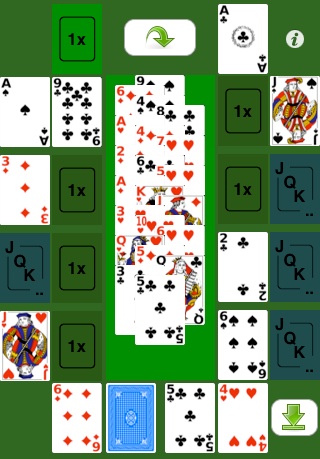
A few moves later our tactic was rewarded. Since the top corner free cell is empty now, we can drag the lowest braid-card there. The other empty free cells should be filled with soon-to-be-useful-cards. Here it would be mostly Q, K, or Aces.
An alternate rule (activate via the info panel) allows dropping to all free cells, but it adds a few cards to the braid.
Lady Cadogan describes this game in the following way in her book Lady Cadogan's Illustrated Games of Solitaire or Patience, New Revised Edition, including American Games (Lady Cadogan 1914, Note: This work´s copyright has expired.):
RULES
I. The foundations follow suit.
II. The lowest (or twenty-eighth) card of the herring-bone is alone available until its removal releases the next one (i.e., the uppermost card of the fan above it), then the second card of the fan becomes the available one, then the third, then the single card above the fan just played, and so on, the removal of each card rendering the next one available.
III. All the cards in the side scenes and the four bars are available.
IV. Vacancies on the bars are refilled from cards of the herring-bone (Rule II), but vacancies on the side scenes may only be refilled from the pack or talon.
PLAY
Deal out twenty-eight cards, beginning from the top (see tableau), thus: Three at the top, placed fan shape, then a single card half covering the fan, then another fan half covering the single card, then another single card, and so on till you have seven fans and seven single cards: this is called the herring-bone, the last card being a single one and available. (Rule II.)
You next deal out eight cards, four on each side the herring-bone: these are called side scenes. Then place one card horizontally above and below each side scene: these are called bars. When these forty cards are placed, the next card dealt becomes the foundation, and is placed in one of the allotted spaces, the other seven cards of similar value being placed as they appear on the tableau, or during the deal.
Four of the foundations ascend in sequence and four descend (Rule I), and it is best to place the ascending on the right side, the descending on the left.
When the tableau is complete, and the first foundation has been played, examine the whole and play from the herring-bone, bars, or side scenes any foundations or other suitable cards. Always choose, in preference, cards from the herring-bone or bars, as on the removal of the herring-bone the success of the game mainly depends, and if a bar is removed, the available card on the herring-bone replaces it, thus releasing the next. (Rules II and III.)
Having played and refilled all spaces, proceed to deal out the entire pack, playing all suitable cards, and refilling spaces; the unsuitable cards forming the talon. In forming the foundations, one card at a time may be exchanged from the ascending to the descending sequence, and vice versâ.
The talon may be taken up, shuffled, and re-dealt twice.
Note. It is so exceedingly disadvantageous that there should be duplicate cards in the herring-bone, that in the German variety of this game the herring-bone is set out from a single pack before the two packs are shuffled.
Good Luck!

